MENU TO FIDDLE STYLES:
Welsh Fiddle
If the fiddle in England has had something of a bad press, it can feel lucky compared to Wales, which until very recently has had no press at all. Welsh folk music was all about harps and choirs, and if you played the fiddle, it was more than likely that you'd be playing Irish music.
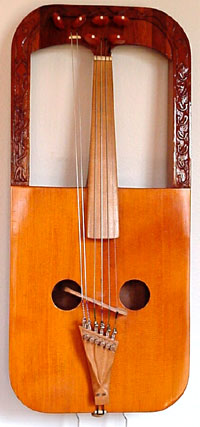
The Crwth- an ancient Welsh Fiddle
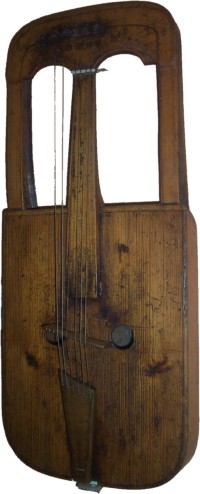
Originally a type of plucked lyre, the crwth was modified when the bow arrived from the continent some time after 800AD, with the addition of a fingerboard. It has four melody strings over this fingerboard, plus two bass drone strings over to the left, which can be either plucked or bowed. In medieval times music was sponsored by the nobility, and court musicians underwent a rigorous training on the harp and crwth, after which they achieved considerable status. The Crwth was widely played throughout the British Isles and the continent, but gradually retreated as the violin spread, so that by the 18thC it was only found in highland Wales. The National Library of Wales records the last crwth player as being John Morgan in Anglesey, around 1740.
The Crwth; this one was made by Hank Talyor. Contact Hank at:
(850) 877-6210
e-mail: jhtayl@gmail.com
Tallahassee, FLOnly four original crwths survive. The oldest of these is the foelas crwth from Pentrefoelas in North Wales; the date carved on it is 1742.
It can be seen today in the Museum of Welsh life at St Fagen's, Cardiff.
18thC Welsh Fiddle
Fiddling reached its peak of popularity in the 18thC, when the Isle of Anglesey alone is said to have had over 40 fiddlers. Among them was Richard Morris , who left a list of tunes from his wide-ranging repertoire in around 1717; of 379 titles less than a quarter were Welsh. By contrast Morris Edwards' collection from 1778 was around three quarters Welsh, though that may be because of his own particular interest in Welsh tunes; certainly the 18th C seems to have seen a steady decline in the use of Welsh tunes. Marches, hornpipes, jigs, minutes and 3/4 tunes are all represented but, unlike their English or Irish counterparts, Welsh fiddlers seem to have played very few reels.
John Thomas left a large collection-over 400 tunes-from around 1752. He was based in mid-Wales, it has a large and varied scope, covering everything from 16thC Welsh tunes, to Handel, Playford and recipes for cooking trout.
In 1850 the Reverend Meredith Morris records seeing eight fiddler at a fair in Yerbeston, Pembrokeshire. Many would have been gypsies; these families seem to have been central to much of the Welsh fiddle tradition. Indeed it is said that the first fiddle in Wales was brought by the gypsy Abraham Wood.
Towards the end of the 18thC, the grip on Nonconformist religion on Wales was such that the fiddle, associated as it was with drinking dancing, the devil and all his earthly pleasures was hounded out, to be replaced by choral singing and the harp, smugly clinging to its angelic connotations. In the early 19th C, when English West Gallery fiddlers were merrily pelting the congregations with orange peel, the Welsh fiddler was already all but extinct. Only a few gypsy families, self-appointed outlaws from Welsh society, managed to maintain any of the tradition, and if the early 20thC collectors with their notebooks and sound recorders ever made it to Wales, they didn’t find the gypsies. As a result, even though we have a reasonable knowledge of the repertoire used by Welsh fiddle players, we have very little idea of style.
Revival of Welsh Fiddle
The late 20th C saw a rise in Welsh nationalist feeling. The Welsh language was revived, English holiday cottages were burned, and eventually the Welsh got their own Parliament. The time was clearly ripe for the rebuilding of the fiddle tradition , albeit on some distinctly shaky foundations. An album entitled “Ffidil- Traditional Welsh fiddle music” was released in 1997 with 13 players, many of them working in duos; among them were Bernard and Gerald Kilbride, Sian Phillips, Stephen Rees and Huw Roberts. Inevitably, there is little common ground in terms of style and ornamentation. Huw Roberts, for example, goes for a classic English approach, heavy on drones and double stops, but relatively plain and unornamented otherwise. Stephen Rees, on the other hand, takes a more celtic approach with fewer drones and more ornamentation.
The Crwth is being revived, Cass Meurig being the best known modern player; she released an album dedicated to the instrument in 2004. She works solo as well as with various combinations including the band Pigyn Clust. Other players include Bob Evans of the group Bragod, who appears on the Ffidil album, and Dan Morris of Cilmerri.
Cass Meurig with Crwth
There is also an annual Welsh Fiddle Festival held in Pembrokeshire, which is helping to create a forum for the revival. Whilst there are many Welsh tunes in the repertoire, a lot of these come from the choral or harping tradition, and still others, such as “Pwt ar y Bys” (Butter and Peas) are early English imports given Welsh titles. There is also as yet little agreement as to what might constitute an authentic playing style; however, it’s early days, and we might yet see the day when the devilish fiddlers replace the haloed harpists as the musical symbol of Wales.
__________________________________________________________________________
CUFFERN MANOR WELSH FIDDLE DAY (NOV 14-16 2014)
___________________________________________________________________________
Links:
Welsh Fiddle Tunes; 97 Traditional pieces for violin, by Sian Phillips (Schott)
Reviewed by Chris Haigh for www.fiddlingaround.co.uk
For a nation with such a rich musical tradition, Wales has for a long time made a very poor showing when it comes to fiddle music, particularly by comparison with Ireland and Scotland. Since the late 19thC, folk music in Wales has focussed almost exclusively on the harp, with the fiddle, ever the victim of nonconformist disapproval, relegated to a tavern instrument.
In recent years, however, there has been a strong revival of the Welsh folk scene, with fiddle once more coming to the fore, championed by players such as Cass Meurig, the Kilbride Brothers, Idris Jones, Graham Pritchard, and the author of this book, Sian Phillips. Although there are several published tune collections from the 18thC, such as those by Morris Edwards and John Thomas, Sian’s collection of 97 tunes has done a great deal to make the repertoire widely accessible.
The presentation is clear and uncluttered, and where tunes have been adapted from vocal or other instrumental sources, suitable fiddle friendly keys have been used. Most are jigs, reels, polkas and waltzes along with a few slip jigs and hornpipes. They are simple and easily playable tunes, each nicely demonstrated by the solo fiddle recording. Very occasional rolls and grace notes are annotated, but, as Sian points out, “Ornamentation is simple….it is up to the individual to lend their own interpretations…”
The introduction and background notes are tantalisingly short, but there are some fascinating snippets, such as the mention of the crwth/fiddle hybrid observed by Rev Meredith Morris in 1908, or the “chocolate box” fiddles played by the gypsy duo, the Wood Brothers
. An invaluable book for anyone interested in Welsh Fiddle.
Return to fiddlingaround.co.uk homepage
Chris Haigh is a freelance fiddle player based in London. He works with the barn-dance band Quicksilver, and has written an album of new English "traditional" tunes for use in media productions; these have appeared on programmes such as The Archers (during a maypole dance), Emmerdale, Bargain Hunt, and the American tv drama series Angel.