
MENU TO FIDDLE STYLES:
_______________
VISIT THE FIDDLE CHANNEL FOR FREE FIDDLE LESSONS, TUTORIALS, AND WORKSHOPS!
Irish Fiddle
LEARN IRISH FIDDLE ON THE FIDDLE CHANNEL So what is there to learn about playing, or indeed listening to and appreciating, Irish fiddle music? Perhaps the first thing to consider is that, perhaps more so than in any other European fiddle tradition, ornamentation is vital. Buy yourself a book of fiddle tunes and play through a few. If you’re a good reader you’ll probably find the tunes quite simple and easy to play- simpler, certainly, than a set of Scottish tunes. However, if you compare the result with any of the recordings which inspired you to start in the first place, you’ll almost certainly find something sadly lacking. The tiny bits of ornamentation- the rolls, cuts and flicks of the bow, which are not written down on the basic tune, are the life and soul of Irish music. They are the difference between plainness and beauty, mediocrity and brilliance, Geoffrey Archer and William Shakespeare.
Kevin Burke, in an interview with Fiddler Magazine, explained the relationship between melody and ornament in Irish music:
"An Irish tune when written is usually kept quite simple, a skeleton version, and it's up to players to "flesh it out" with their own ideas and variations, ornaments etc. Because the tunes often change from player to player I think the written versions are deliberately kept vague in case being too specific allows them to become"static". The changing nature of the tunes is part of the charm of this kind of music"
Irish Fiddle Ornamentation
Ornaments can be either fingered or bowed; whilst in Scottish fiddling bowed ornament predominates, in Ireland the fingering is more important. Tiny grace notes are very common, and can appear in several different contexts.
1.The Cut. Where two notes of the same pitch lie together in a tune, they will often be interrupted by a single grace note called a cut. The grace note is usually higher than the melody note; If the tune has a B note (ist finger) on the A string, for example, the cut would usually be from the D note (3rd finger, A string) or possibly the C (2nd finger) The grace note is a mere flick- don’t apply enough pressure to let the note sound clearly. The grace note is not bowed separately, but slurred into the note it precedes
2.The Double Cut. Here two grace notes are used instead of one. The melody note is preceded by the same note plus a higher note-classical players would think of it as an upper mordent. For example a B note (ist finger) on the A string would be preceded by B and D (1,3) or B and C (1,2)
3.The Long Roll. Particularly important in jig playing, this turns three quavers, either separate or slurred, into 5 notes. For example, take a single E note (1st finger, D string), lasting half a bar of 6/8, ie a dotted crotchet. This could be split into five notes; EGEDE or 13101, all slurred together. The five notes can be given equal length, or there may be more stress on the first one. Many players treat the roll more as a rhythmic than a melodic ornament, with the notes played so fast that they are not heard clearly.
4. A Short Roll is exactly like the long roll, except that the five notes are squeezed into a crotchet instead of a dotted crotchet. In a roll the notes are always slurred together.5.The Cran. Many Irish fiddle ornaments are direct imitation of pipe ornaments, and this is particulalry so with the cran. The pipes are unable to stop the flow of air within a tune, so on a D note, for example the piper has to add non-melody grace notes if he wants to interrupt the note. For a fiddler, the cran is the equivelant of an open string roll. Instead of fingering 01030, which would involve string crossing, he will play 0210.
6 . The Slide. Instead of hitting the note squarely, the Irish fiddler will sometimes approach the note from below, starting maybe half a semitone down and sliding swiftly and smoothly up to the correct pitch. The slide is most commonly used at the start of a phrase, and will be applied to just one or two key notes in a tune.Bowed Ornamentation
The most common bowed ornament is the bowed triplet or treble. Here a note, usually a crotchet, is split into 3 very short, individually bowed notes. The effect is actually more of a flick or stutter than three clearly discernable bows. It’s usually bowed down-up-down, but up-down-up is also used. It's the ornament most likely to disrupt a fiddler's bowing, so ideally you should be proficient in both up and down bowed trebles. This ornament, which is interchangeable with the short roll, is most common in the Donegal style of fiddling. Tommy Peoples of Donegal is often cited as the leading exponent of the treble, which he executes with great speed and precision. Whilst most players will only use trebles on a reel, Peoples also uses them whenever he plays jigs. In reels, he will sometimes play a treble on a quaver, instead of on a crotchet.
In very crude terms, the treble can be seen as being a Scottish influence, which is strongest in the north of Ireland, receding as you head south. In Scotland it is known as a birl, or in Shetland a shiver, and in Cape Breton as a doodle or a cut; (confusingly, since it is not the same as the Irish grace-note ornament described above).
The History of Irish Fiddling.
Irish fiddle playing today has never been more vigorous, whether at a professional or amateur level, with an extremely high standard of playing and a strong demand for the music both in Ireland and elsewhere. As early as the middle ages Ireland had an international reputation for the quality of its musicians. The Norman Girald Cambrensis visited the country in 1185. In general he was not impressed, referring to the Irish as being “so barbarous that they cannot be said to have any culture” However, when it came to the music, it was a different story. “They [the Irish] seem to be incomparably more skilled in [musical instruments] than any other people that I have seen. The movement is . . . rather quick and lively, while at the same time the melody is sweet and pleasant. It is remarkable how, in spite of the great speed of the fingers, the musical proportion is maintained.”There were numerous stringed musical instruments in use at the time; the accurate naming and descriptions of these is open to a good deal of confusion. Three different names are given to types of lyre ; the cruit the crot and the timpan- all were plucked instruments (the timpan was not a drum despite the connotation of its name). By the 11th or 12thC the bow had been introduced to Ireland and, as happened in England and Wales, there was a rapid evolution as the lyres were adapted for bowing. At around the same time. The Irish Harp (cláirsech), meanwhile, established itself as the highest status instrument; harp players were highly trained professionals, retained by a chieftain.
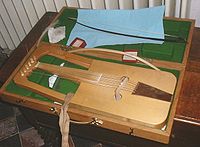
Crwth The first known reference to the fiddle in Ireland comes from a description by O’Curry of a trip to a fair at Carman at which he saw "Pipes, fiddles, chainmen, Bone-men and tube players ". This description dates from the 7thC, which seems too early for any bowed instrument to have been used in Ireland; most likely some mistranslation or misinterpretation is involved. An excavation below a house in Christchurch Road in Dublin during the 18thC uncovered what is said to be the oldest actual bow known in Europe, dating from the 11thC, along with a medieval fiddle. The bow is of dogwood, and has an animal-head carving at the tip.
By 1674 the fiddle was well established; Richard Head wrote that in Ireland "in every field a fiddle, and the lasses footing it till they were all of a foam " Initially this would have been the medieval fiddle, but eventually the standard violin was introduced, probably via the Ulster Scots.The harp gradually declined in importance, perhaps in no small part because of the displacement of the Irish upper class- chief patrons of the harp, due to repeated Norman, English and Scottish incursions. The fiddle, however, cheaper to buy and easier to learn, thrived and was widely played among the rural population of Ireland.
They were mostly played solo; for dances in farmhouse kitchens, or at weddings, fairs, racecourses and streetcorners. for tips. Fiddle playing was seen as practical and functional, rather than as the leisure activity that it is today. Professional fiddlers would travel for many miles around their home town, and the tradition was often passed down from father to son.From the beginning of the 18thC the uillean pipes came into use, and became the chief rival to the fiddle. Though arguably of higher status than the fiddler, the piper would always be outnumbered by Ireland’s fiddlers. It is likely that the majority of tunes in today’s repertoire were written on fiddle rather than pipes or indeed tin whistle or flute, both of which were introduced in the 19thC.
The great famine of 1845-49, when the staple food crop of Ireland was destroyed by the potato mould, had a devastating effect on society as a whole, but in the long run was beneficial for traditional music. Faced with starvation and eviction by unsympathetic landlords, those with enough remaining strength and money emigrated, many of them to the United States. Here in east coast cities such as New York, Boston and Chicago, although life remained a struggle, there was a great deal more opportunity to earn a decent living. Fiddlers found a ready audience in minstrel companies (of which there were over a hundred in the 1860’s), variety theatres and Vaudeville shows, feeding an insatiable nostalgia for the “old country”. In common with most other émigrés, people in the Great Melting Pot found their identity not always diluted, but often reinforced by separation from the homeland. With more money and perhaps a little more leisure time, the idea of playing fiddle purely for enjoyment would have taken a hold. Now it was possible for Irish Americans to hear and learn from fiddlers not just from their own village, but potentially from all over Ireland
Irish traditional music in the 20th Century
By the 1920’s the recording industry was taking off in America, and the new recording companies knew that there was a ready market for music representing all the different ethnic groups still flooding into the country. First off the block was fiddler Patrick Clancy, who in 1919 recorded four medleys for the Victor Talking Machine Company. Also among the first, and certainly the most influential Irish fiddler to join this trend was Michael Coleman.
Michael Coleman
He was a highly gifted fiddler, his Sligo style highly ornamented and expressive. Along with others such as James Morrison and Paddy Killoran, he put down 78RPM recordings of fiddle with (often ham-fisted) piano accompaniment, and sometimes with other instruments such as pipes, banjo, accordion or flute. This new combination of instruments, along with the time limitations of the 78’, meant that the old idea of extended repetition with variations was a thing of the past. Snappy arrangements were created with maybe two tunes each played twice through.
These recordings were hugely popular both in America and back in Ireland. Their significance in terms of the development of Irish fiddling was huge. Here suddenly was a standardized format of style, arrangement and repertoire which was available not just to the audience at a céilí or fair, but to thousands, musicians and non-musicians alike. The downside was that the “New York style”- an amalgamation of all Irish styles (but, due to the towering presence of Michael Coleman with a strong bias towards Sligo), began to erode and eventually largely destroy the huge and diverse patchwork quilt of styles that had developed across Ireland. Almost everyone who heard these recordings saw the future of Irish music staring them in the face, and that was how they wanted to play from now on. The upside was that a new generation of fiddlers could learn not just at their father’s knee, but from the exciting and invigorating music of master musicians. Fiddlers found a new pride and respect for what was rapidly becoming seen as a performance art, worthy not just of the kitchen but perhaps of the concert hall as well.Donegal fiddler Danny Meehan, in an interview with Fiddler Magazine, confirmed the huge influence of Michael Coleman on his generation of fiddlers:
You couldn't help but be influenced by him. Any traditional musician in the world, they wouldn't be but influenced by Coleman...T'was all meticulously played with a nice pace and nice bits of imagination here and there; a very lyrical player....Coleman did influence everybody.
Up until the early 20thC, most traditional music and dancing took place either in people's houses and kitchens, or at informal gatherings at fairs or crossroads. Musicians usually performed solo. Due in part to increasing disapproval from the church, and also to the effect of the Gaelic League, set up to promote and effectively to formalise dance and music. the house dance gradually declined. In the words of Colette Moloney;
"The former amateur, communal, informal performance setting was replaced by musicians forming themselves into bands to perform in the more disciplined, organised, formal and uniform style favoured by the dance hall....many local traditional musicians simply stopped playing"
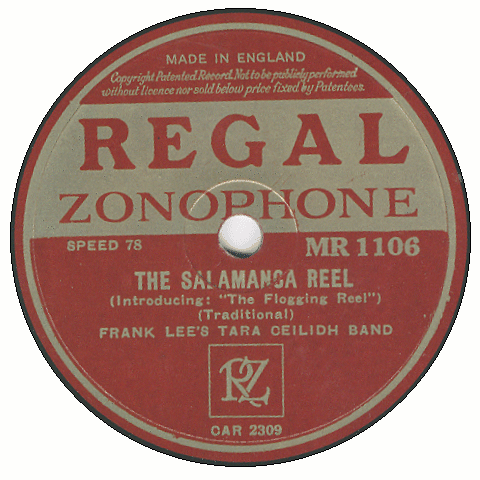
The repertoire changed considerably to deal with the new setting; set dances such as The Seige of Ennis became the staple, whilst quadrilles, schottisches and mazurkas all but disappeared. The term “céilí band” was probably coined by Frank Lee, who’s Tara Céilí Band came together to celebrate St Patrick’s day in London’s Notting Hill in 1918.
In 1926 the recently formed Irish Free State, anxious to bolster a spirit of Irish nationalism, created its own radio station. By the following year there were regular broadcasts of traditional music featuring Dick Smith’s Ceili Trio of fiddle, piano and flute. Soon ceili bands were appearing all across Ireland as well as in America and England. Alarmed at the prospect of the good people of Ireland having too much fun, the Catholic Church and the Irish government colluded to ban unlicensed house dances under the Dance Halls Act of 1935. In 1924 the Bishop of Galway, not mincing his words, had stated “The dances indulged in are not the clean, healthy national dances but importations from the vilest dens of London, Paris and New York, direct and unmistakable incitements to evil thoughts and evil desires". Nice one Bishop. Though music as such was not specifically proscribed by this ban, it obviously had a severe effect on musicians, particularly in terms of morale, and many left for America.
For an amusing and informative view of the attitude of the Catholic Church, read John B Keane's "The Bodhran Makers". It is set in rural Ireland in the 1950's; a group of traditional musicians, the "Wren Boys" organize their annual session/party/drunken orgy one saturday night at the house of one of its members. The party is "raided" by the Parish Priest. "How dare you abuse the Sabbath, you ungodly wretches!" he rants; "Here it is, two o'clock in the morning, with the first mass only five hours away and drunkenness rampant. How often have I told you that you may not hold these porter balls when they intrude on the sabbath day, the day specially set aside by God for worship..."
The indignty of this attack, combined with the poverty of their existence finally causes many of the musicians to emigrate to England. The Prest eventually loses his marbles and is carted off to hospital with the sound of a non existent bodhran ringing in his ears.
The Revival of Irish music
In common with many other kinds of traditional music, Irish music took a big downturn in the 40’s and 50’s as swing, rock and roll, and general postwar optimism saw a new generation turning their backs on what was seen as a tired and outdated genre. Concerned by the decline and potential demise of traditional playing, a group of musicians got together in Dublin in 1951 and formed Comhaltas Ceoltóirí Éireann (“gathering of musicians of Ireland”), commonly referred to as just Comhaltas (key-ol-tas). Their aim was to promote Irish traditional music , dancing, language and culture, and to establish an annual national festival and competition or Fleadh. From small beginnings this festival grew rapidly and branches of Comholtas were established throughout Ireland and overseas. Classes teaching instruments and dance to young children became widespread, and the competitions have consistently driven up the overall standard of playing.
A key figure in the modern development of Irish music was Seán Ó Riada. Born in 1931 in Cork, he was one of the first musicians to learn traditional music, before moving on to a thorough classical training. Writing for film, radio and theatre, he gave Irish music a higher status among the arts cognoscenti than it had ever achieved. The ensemble he put together for live performance, Ceoltóirí Chualann, (whose line-up included fiddlers Sean Keane, Martin Fay and John Kelly) broke new ground in its presentation of Irish traditional music presented almost as chamber music, with rich new textures, harmonies and arrangements. Although a leading champion on Irish music, he was no fan of ceili bands, likening them to the buzz of a bluebottle in an upturned jam jar!. Whilst his group was short-lived, it produced an offshoot in the form of The Chieftains which became arguably the most successful traditional Irish band ever. The band, led by the jovial piper Paddy Moloney, included fiddler Martin Fay, who was joined and eventually replaced by Sean Keane. Since their first album release in 1964 they have travelled the world, including a notable trip to China in 1983, frequently collaborating with musicians and singers from widely different genres and cultures.
In the late 1960’s, along with peace, love and the Beatles (and it’s rumored that someone was seen smoking a joint one night on Grafton Street!), came a new enthusiasm for all things down-home, wholesome and folky. With armies of young people now playing instruments, the pub session finally became established in Ireland, (It had been around since the 40’s among ex-pats in London and the USA- see the feature below) and a new market opened up for bands playing not just the old traditional Irish music, but experimenting with new instruments, sounds and textures. The accordion, guitar and, shortly after, the bouzouki were added to the musician’s armory, and bands like Planxty and the Bothy Band found new ways of mixing and incorporating songs and instrumentals. Fiddlers such as Tommy Peoples, Paddy Glackin and Kevin Burke all served time in Planxty, while Mairéad Ní Mhaonaigh hit the world with her group Altan, and Frankie Gavin with De Dannan. Such supergroups were and still are able to sell bucketloads of records, and play to packed venues all over the world, with a standard of playing, whether in terms of precision, performance, imagination or expression which would have been unthinkable in previous generations.
TUNE TYPES IN IRISH MUSIC
The repertoire of Irish traditional music is huge. In his book Pete Cooper suggests that there are around 6000 tunes currently in circulation. They fall into a number of distinct categories, based on their rhythm and structure:Reels are fast tunes in 4/4 time (or more accurately, in cut time). Reels are the staple diet of Irish traditional sessions the world over, usually outnumbering all other tune types by a large margin. They were imported from Scotland in the late 18th C, but have now developed their own style in Ireland, and make up a large part of the repertoire. They are made up mostly of eighth notes (quavers) which may be played straight, or given a swing a bit like hornpipes.The pulse of a reel can either be on the first of each four quavers (the on beat), or on the third (the off beat or backbeat) The latter approach, similar to the American Georgia shuffle, is frequently used by Kevin Burke. Patterns in which the bow rocks across two strings are common in reels. Most reels have repeated eight-bar sections, making 32 bars (eg. the Star of Munster, the Merry Blacksmith,) Less common are 3-part (48 bar) reels such as the Flogging Reel or the Moving Cloud. Single reels are those in which the 8-bar sections are not repeated. Examples of two-part single reels include The Wind that Shakes the Barley, the Monaghan Twig, and Drowsy Maggie. Single reels can also be three-part (The Flogging Reel, the Longford Spinster, Boys of Malin); four part; (Lord MacDonald’s), or five-part (Bucks of Oranmore).
Reels are usually fast and flashy, showing the fiddler's technique to good effect, though Martin Hayes is known for playing reels in a very slow and expressive fashion.
LEARN A SLOW REEL, MARTIN HAYES STYLE;
Hornpipes were introduced from England. They are similar to reels, but with a bouncy, "humpty dumpty" rhythm created by lengthening the first of each pair of quavers, and shortening the second.. They tend to be played slower than reels, particularly when played for dancing. A hornpipe can be reliably identified if the 8 bar line ends with three even crotchets, as for example in the sailor’s hornpipe. Hornpipes tend to be more melodic than reels, and with more harmonic interest, and frequent triplets are a common feature. Arpeggiated phrases, chromatic notes and implied non diatonic chords are all common in hornpipes. Examples include Harvest Home, Boys of Bluehill, Stack of Barley and Off to California. Listen to Frankie Gavin’s take on The Wonder Hornpipe, which more than lives up to its name.
Polkas are played faster than reels, but feel steadier as they have far fewer runs of quavers. They are in 2/4 time- ie two crotchets to the bar. They are used for a couple dance which originated, probably in Poland, in the 1830's. The polka was soon a popular throughout the ballrooms of Europe, before filtering down to the dances of ordinary people. Polkas are often very simple melodies, and a particularly prevalent in the Sliabh Luachra rogion of Cork, Kerry and Limerick. Among the leading exponents were Julia Clifford and Denis Murphy, a brother and sister from county Kerry, and more recently the fiddler Matt Cranitch from the band Sliabh Notes.
Examples of well known polkas include Maggie in the Wood, The £42 cheque, Farewell to Whiskey, and Denis Murphy's Polka. Britches full of Stitches is a particulalry easy tune to learn, as it is based on a pentatonic (five note) scale.
Jigs, among the oldest form of Irish dance tune,, have a bouncy 6/8 rhythm, with a stress at the beginning of each three notes (rashers and sausages) Examples would be Haste to the Wedding or Lannigan's Ball. You may sometimes hear the term double jig; this is in fact the normal form. The term “double” in reference to jigs refers to the “double battering” step used by dancers.
Jigs are occasionally three-part (such as Dingle Regatta) or four-part (The Lark), but like most Irish tunes are usually 2-part.A single jig has a simpler rhythm (boil the eggs and cook the bacon), and is sometimes notated in 12/8 time. The best known examples include Smash the Windows, Hag at the Churn and Off She Goes.
Slip jigs. Far less common than ordinary jigs, these have a similar feel but are in 9/8 (cooking my rashers and sausages). The slip jig is used for a graceful soft shoe stepdance, usually danced by women only, and also for the ceili dance Strip the Willow. Among the best known are The Butterfly (a composition by Dublin fiddler Tommy Potts), Rocky Road to Dublin, Drops of Brandy, the Kid on the Mountain and the Foxhunter’s Jig.
Slides; similar to jigs again, but in a brisk 12/8 time; found only in the south west of Ireland. They can be distinguished from jigs by the long melodic phrases which would not fit into a bar of 6/8 (cooking my taters and rashers and sausages) Examples include Star above the Garter, Hare in the Corn, and Kilfenora Jig.
Mazurkas. Like Polkas, Mazurkas originated as couple dances in Poland (a Mazur being an inhabitant of the province of Mazovia). They are in 3/4 time, but unlike the waltz, the accent is usually on the second beat of the bar. Examples include Johnny Doherty's, Charlie Lennon's, and Sonny's Mazurka. They are played somewhat faster then waltzes. They have become particulalry associated with Donegal music.
Slow airs, derived in part from the sean-nos (old style) gaelic singing, are only occasionally played at sessions, and make more demands on tone and intonation than do the dance tunes. They are played rubato, and with a great deal of expression. Examples of well-known slow airs include An Chúilfhionn (The Coolin), Bean Dubh a’Gleanna (Dark women of the Glen), Sliabh Geal Gcua (Fare you well), and The Wounded Hussar. Slow airs are an important feature of fiddle contests at the fleadh; in the adult category the playing of one is compulsory. It is said that to perform one properly, you need to be familiar with the gaelic lyrics, otherwise the phrasing will make no sense.
The Tin Fiddle
In the early 20thC fiddles made of tin became popular in Donegal, the wild and remote county of north west Ireland. They were made, and mostly played, by travelling tinsmiths. The big advantage of the tin fiddle was that it was cheap and easy to make- no more than a couple of hours work to a skilled tinsmith. They were light and easy to repair, and also quieter and duller in tone than a normal fiddle, so were ideal for children and beginners, or for travellers and those living in cramped conditions. The neck and fingerboard were usually of wood, often salvaged from a broken fiddle.Perhaps the best known user and maker of the tin fiddle was Johnny Doherty. He and his family preferred to play wooden fiddles, but when times were hard they would sell these and make new tin instruments to replace them. As well as the Dohertys, the McConell and Irwin families were also well known for the making of tin fiddles. Some still survive today and are greatly prized by their owners.
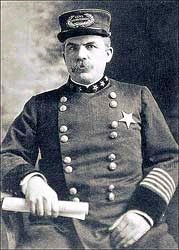
There are many fine collections of Irish fiddle tunes in print, some of which concentrate on those numbers most commonly played at sessions, but a special mention must be made of "O'Neill's Music of Ireland". This vast collection of over 1000 tunes represented the repertoire and life's work of Chicago Chief Superintendent of Police Francis O'Neill, a late-19th Century emigre from West Cork.
Worried that this music was in decline, he enlisted the aid of fellow policeman and namesake James O'Neill, from County Down, to transcribe what he could remember of the tunes he had heard as a boy. Though a talented flautist, the chief could not write music. James on the other hand was a trained violinist and had both the patience and enthusiasm to write down the tunes his friend played. Soon this endeavour became known to other musicians in Chicago,and in no time fiddlers, pipers and flautist were lining up to have their tunes copied in this way. The chief would book them in, and the three would sit together; James annotating the tune then playing it back to the performer, who could comment on and correct the transcription. O'Neill was always on the lookout for new blood, and as soon as he heard of a new musician arriving in the country, he would invite them to Chicago, often with the offer of a job on the force.
His collection grew rapidly, and over 2000 tunes were published in two collections; "the music of Ireland" in 1903, and "Dance music of Ireland" in 1907. The significance of these collections cannot be overemphasised. Whilst others had tried similar endeavours before (Edward Bunting published a set of Harp tunes in 1792, and George Petrie followed in the early 19th C with several collections of Irish Airs), these earlier collectors had little real understanding of the music they were listening to, and ended up with tunes written in the wrong key, with inappropriate accidentals, piano accompaniments, and intended solely for the drawing rooms of the nobility. For actual practitioners of folk music they were next to useless.O'Neill, on the other hand, was surrounded by such practitioners, and went to great pains to get as accurate as possible a record of the tunes as actually played. In a 2011 article in Fiddler Magazine, Caoimhin Mac Aoidh examinied the accuracy and authenticity of O'Neill's transcriptions, and was able to draw on some remarkable evidence. Around the turn of the 20thC O'Neill got hold of one of Thomas Edison's new cylinder recording machines and made recordings of some of the fiddlers and pipers from whom he was collecting tunes. Some of these cylinders were rediscovered in 2003. Among the recordings were some by Tipperary-born fiddler Edward Cronin, including the three part jig Banish Misfortune and the set dance The Blackbird. O'Neill's records show that this was the same fiddler who had contributed the tunes to his written collection, allowing us to directly compare his transcriptions against what was actually played. The result is that we can confirm that his transcriptions were indeed remarkably accurate.
Regional Irish fiddle styles
Much as spoken dialect varies across the length of a country, so does the style of traditional music playing; in the case of Irish fiddling the regional variations have been well studied and documented. Click HERE for a more detailed discussion of regional fiddle style in Ireland.
DONEGAL FIDDLE STYLE
The style of Donegal, in the wild north west corner of Ireland is fast and aggressive, with an emphasis on short powerful bow strokes and frequent bowed triplets; reels are usually played without much swing. Fingered ornamentation is sparse. Droning and double-stopping reflect the influence of piping, whilst the schottisches and strathspeys betray the strong Scottish influence. John Doherty, who died in 1980, came from a long line of travelling musicians, and his four brothers were also great fiddle players. John's playing was marked by his fierce and powerful tone. Although his saw-style bowing could at times appear crude, he in fact had a wide range of specialised bowing techniques. Among his party pieces were the highly descriptive “Hunt of the Hounds and the Hare”, and his uncanny bagpipe imitations.
One of the Doherty brothers, Mickey Doherty, commenting on the family's relationship to music, said "it came to our people like a cat drinking milk". In 1951, tune collector Alan Lomax was travelling in Donegal, and Mickey was among those he recorded. He appeared on an LP "The Folksongs of Britain", first released in the USA, and later re-released in 1968 by Topic Records. He had first played as a child on a tin fiddle made by his father, and Mickey himself became a tinsmith and also made tin fiddles. The repertoire Mickey played for house dances included Mazurkas, Highlands, Germans (or Barndances), Sets, Lancers and Varsoviennes.
Among the leading exponents of this style today is Tommy Peoples (one-time member of the seminal group The Bothy Band); Tommy is known for the richness and complexity of his ornamentation, particularly the bowed trebles. He is often described as being a highly individual player, much more than just a product of the “Donegal style” Other noted Donegal fiddlers include Liz Doherty, who also has strong Cape Breton connections, Paddy Glackin ,who preceded Peoples in the Bothy Band ; and the leader of the leader of the highly successful Altan, Mairead Ni Mhaonaigh.
SLIGO FIDDLE STYLE
Sligo is the beautiful, wild and rural northwest corner of Ireland. The fiddle style of Sligo has been very influential, largely thanks to Michael Coleman (1891-1945), who emigrated to New York from Sligo, and produced some of the earliest recordings of traditional Irish music during the 20's and 30's. His is a light, bouncy style, rich in ornaments and combining the bowed triplets of Donegal with much of the rolling and slurring found further south. Double stopping, and the use of both single and slurred bows are also features of the Sligo style. Unlike the Donegal fiddlers, Sligo players use a lot of swing in their reels. Other Sligo fiddlers who emigrated to the US and also made influential recordings include James Morrison, Paddy Killoran and Paddy Sweeney. Michael Gorman was another Sligo emigree, but this time to England. Many of his recordings from the 50’s to the 70’s can be heard on the Topic re-release Michael Gorman; the Sligo Champion. Among the leading players in this style today is Kevin Burke, yet another alumnus of the Bothy Band, and more recently acclaimed for his work with Open House, Patrick Street and Celtic Fiddle Festival. Other influential Sligo fiddlers today include John Carty and Paddy Ryan.
CLARE FIDDLE STYLE
The Clare style is different again, and is particularly characterised by the slow tempos , the subtlety of ornamentation, and the use of long, fluid bow strokes covering many notes at a time. Champion of this style is the widely revered Martin Hayes, now resident in Seattle; he achieves what he calls the "lonesome touch" by deliberately copying the breathing and sensitivity of the human voice.
SLIABH LUACHRA FIDDLE STYLE
Sliabh Luachra (“the Rushy Mountain”) is an area in the counties of Kerry, Limerick and north Cork. It has a strong tradition of fiddle and box playing, often in association with the dancing of sets. There is a distinctive repertoire, including many slides and polkas- tunes rare in the rest of Ireland. Slow airs are also widely played. Ornamentation is mainly from the left hand, with the bow providing a driving rhythm. Polkas are bowed with a distinctive “doo-wah”, with pairs of quavers slurred, but with an extra bow pressure on the second of the pair. Open string drones are common, as is the practice of “reversing” (where two fiddlers play in unison, but in different octaves).
Padraig O'Keefe (1887-1963) was an important figure, often thought of as defining the style. Among the fiddlers he taught were Denis Murphy and his sister Julia Clifford, who in 1967/8 recorded a highly influential album “The Star above the Garter” Other Sliabh Luachra fiddlers include Paddy and Johnny Cronin. Matt Cranitch, from County Cork, is one of the leading contemporary exponents of Sliabh Luachra fiddling, through performances with his band Sliabh Notes, through academic writing, lecturing and teaching, and through his publication “The Irish Fiddle Book”
Galway has many fiddle tunes in E, Bflat, C and F (This is unusual, as most Irish tunes are in G or D, C or A or a relative minor thereof.) There is an emphasis on melody and tone rather than speed. Among the best examples of players in this style are Paddy Fahey, Eddie Kelly, Sean Ryan, Breda Keville and Liam Lewis
Improvisation and variation in Irish fiddling
Played, as they are mostly in sessions, Irish fiddle tunes are usually played in near perfect unison, with everyone trying to play the same version of the tune, with pretty much the same ornamentation. However, the best players are those who have such command of the language of tune and ornament that they are able to, albeit in a subtle way, create constant variations in their playing. Danny Meehan put it like this: It's to make it interesting for yourself and for people and listeners as well. Melody is not a cut and dried thing...these little notes will slink in without destroying the tune. It doesn't have to be a lot of notes. Just one or two can make a profound effect, like.
Cross Tuning in Irish fiddle playing
Cross-tuning, or scordatura- the retuning of fiddle strings to anything other than the standard GDAE, is a common feature of American Old time, Scandinavian and to some extent Scottish fiddling. It is not however something usually associated with the Irish fiddle. Caoimhin Mac Aoidh, however, in an article in Fiddler Magazine, argues that this is a view that needs revising. One of the simplest forms of retuning is simply to tune all four strings either up or down from standard tuning. This is not as pointless as it may seem. Tuning up the pitch (commonly by a semitone) has three effects; the tone becomes brighter, the sound more powerful, and the strings more responsive to rapid ornamentation. “Playing sharp” was associated with Donegal fiddlers such as Danny Meehan and Neillidh Boyle, and more recently with De Dannan’s Frankie Gavin.
Playing flat, on the other hand, produces a softer, mellower tone. More importantly it allows fiddlers to play with uilleann pipes, often themselves pitched low. This practice occurred throughout Ireland, but was particularly prevalent in County Clare. Evidence of changed- interval cross tuning is common in the history of Scottish fiddling, which has been well documented through tune collections over the centuries. The writing down of tunes was far less common in Ireland, so it is difficult to assess how common cross-tuning was in the past. It seems likely that it was a fairly common practice, but largely restricted to a fairly small repertoire of specialist tunes. These are largely bagpipe tunes. The fiddler Padraig O’Keeffe (1887-1963), for example, one of the foremost exponents of the Sliabh Luachra style, used to play a tune called The Pipe Reel, a variation of the well-known Pinch of Snuff, was played in AEAE. The retuning allows the fiddler to play a pipe- like drone along with the melody. Sean Keane and James Kelly have both recorded AEAE versions of The Foxhunter’s Reel, learned from the playing of Patrick Kelly of County Clare. It is phrased with long single bows, in imitation of the pipes. In Donegal John Doherty and others commonly used AEAE on tunes like The Kedue Piper and Nora Criona, while Danny Meehan played the Rocky Road to Dublin in GEAE. In conclusion, although never widespread, cross tuning has been and remains one of the colours and variations which makes Irish fiddling so rich.
The continuing vitality and integrity of the Irish fiddle tradition owes much to the culture of competitions in Ireland both for children and grownups, of which many of the above fiddlers are veterans and many-time champions, as well as to such organisations as Comhaltas Ceoltoírí Éireann (pronounced, roughly, Kyol-tas Kyol-tori Erin) and the Willie Clancy Summer School.
The Irish Pub Session
More perhaps than any other style of folk music, the "session" is the heart and soul of Irish traditional music. Everyone from beginners to the top professionals spends time at these informal gatherings learning and swapping tunes. They take place almost exclusively in pubs or bars; the musicians will take over a corner which will be theirs for the evening; those taking part do so largely for their own enjoyment; the other drinkers in the pub will not have paid to get in, and will not generally be expected to keep quiet, dispite the fact that there will be no amplification. Some will hardly notice the music, but the landlord obviously believes that the overall ambience benefits from them being there; a steady supply of Guinness may well be supplied "on the house" to keep things going.
Sessions are a curious mixture of informality and etiquette. In any given town or village the regular players will know that certain pubs will have sessions on a certain night of the week, but this will almost certainly change over time; some will fall by the wayside only to reappear somewhere else. There is often a core group, maybe just of a couple of people who have arranged things with the landlord, and can be expected to be there most weeks. and "lead" the session. Sometimes they'll be virtually on their own, some weeks the place will be heaving . Part of the fun and excitement of a session is not knowing who's going to show up on any particular night. Sometimes, on a good night, there might be lots of fiddles, a flute and a bazouki. A good combination Another night it might be four bhodrans and a double bass. Oops! Strangers are always welcomed, but it's always a good idea to ask if it's ok before you get out your fiddle and join in. It's also wise to take note of the standard of playing before you consider joining in; if the other players are all experts, rattling away at the most demanding tunes with obvious ease, then a near beginner is obviously going to cramp their style. Conversely, if the other players are plodding carefully through the Boys of Bluehill at half the normal speed, they may not be impressed if you launch into a high powered Masons Apron with all the trimmings, which is obviously going to leave them standing. The general aim is to find a level at which most of the players can join in together. Everyone respects good players, but egos, along with firearms, are generally left at the door.
There is a repertoire common to players all over the world; regular session goers will know hundreds of tunes, some of which will be considered "overplayed" and will therefore be rarely heard in a "happening" session, whilst new material, either newly written or recently recorded by a popular artist, will suddenly be all the rage.
Someone will usually start a "set" just by launching into a tune, probably without comment or introduction; everyone who knows the tune will immediately join in, and run it round 2 or 3 times, at which point someone-usually the person who started the set, will change tunes without break or pause. Often there will be an established order for the tunes of a set, so that people have a good idea of what might be coming next. This order will take into account continuity of style, feel and tempo, and a natural progression of keys. It's normal for some people to drop out when the tune changes, or for others to join in. It's not a concert, and a bit of hesitation or deviation is fine, but if you don't know a tune, it's not a good idea to blaze away regardless ; either play very quietly, or not at all. Variation, improvisation or plain noodling will get you some black looks. Unison is the order of the day, and even well-thought out harmonies may be frowned upon. The end of a set will generally come when the person who started, perhaps with a nod to the others,ends a tune without starting another. After a pause for a drink and a chat, it'll then be someone elses turn to kick off, and so it goes for maybe hours on end. If you’re new to the session, don’t start off a tune yourself unless invited to; think of the session as if you were sitting down at someone else’s picnic! Sometimes, maybe on request, a player may do a solo party piece which the others will all listen to, and there may be the odd song. Fiddles, flutes, whistles, Uillan pipes,accordions and bodhran are all common at sessions, and, since the "folk revival" of the 60's, guitars, four-string banjos and even bazoukis. Irish traditional tunes will predominate ,but increasingly you may hear something more exotic, whether American, French Canadian or Balkan. The highly unconventional "Music for a found Harmonium" by the Penguin Cafe Orchestra has entered the regular repertoire since it was recorded by Patrick Street.
THE ORIGIN OF THE IRISH PUB SESSION
You would be forgiven for assuming that the informal pub session had been the heart and soul of traditional music in Ireland for centuries. But in fact you'd be wrong, and it seems likely that they in fact started no earlier than the 1940's. And not in rural Ireland, but in the backstreets of North London! I'd heard this suggested several times in recent years, and was recently able to get confirmation of it from Reg Hall, author of the 2-volume text of near biblical proportions, Irish Music and Dance in London.
He told me Certainly until Comhaltas was formed in Ireland 1951 or 2, Irish music was seldom if ever played in pubs in Ireland. It wasn't a question of prohibition; it wasn't what musicians wanted to do. If more than two musicians played together it was most probably in a private house. Of course, traditional music was pretty well despised by town dwellers, even in small towns...
In the 1940's there was a large influx of Irish workmen to London, many doing reconstruction work after the war. They were living in cramped hostels or digs, with no kitchens or space of any other kind to play music, and no wives to supply the tea and sandwiches. Instead they gathered after work in the backstreet pubs of North London; again in Reg's words- Irish music began to be played in London pubs around 1946, when the Irish immigrants began to colonise some backstreet pubs in north London.The first was probably the Devonshire Arms in Kentish Town, and a couple of years later the Black Cap, Camden Town. Throughout the 1950s & 1960s music was played in dozens of pubs all round London. HOWEVER, the music-making wasn't what you would now call a session. They were discrete groups of friends and acquaintances, very often with two or three regulars on the payroll by the landlord.
So Irish music in pubs began in a fairly formal way, and once established it gradually developed into the "come-all-ye" session of today. In Ireland itself the formation of Comhaltas was probably a major catalyst:
At national fleadhs from 1952 onwards, I assume, music was played in some pubs and in the street in the town where the fleadh was held as the musicians were congregating for the event.... Music started to be played in some pubs in Ireland in the mid-1960s, when the lounge bars, largely in towns, began to present ballad sessions.
If anyone has any information on the earliest Irish pub sessions in America, I'd be very pleased to hear from them!
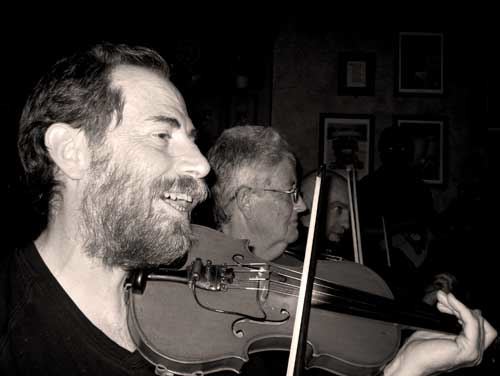
Chris Haigh is a fiddle player based in London; he has a large repertoire of Irish fiddle tunes, and performs either solo, with an irish singer/guitarist, with a larger Irish trad/contemporary band, or with the ceilidh band QUICKSILVER. He has worked with Riverdance.
___________________________
If you fancy playing in an Irish session , but don't know any other musicians, here's a great idea! Get in a crate of Guinness, get out your fiddle, and go to http://www.bbc.co.uk/radio2/r2music/folk/sessions/ for an amazing virtual session with lots of tunes to read and play along with.
LINKS:
- Standingstones; has a detailed breakdown of different regional styles of Irish fiddling
- The Donegal Fiddle Pages: An amazingly comprehensive look at Donegal fiddling
- Sean Keane: his homepage
- Irish Fiddle.com
- Kerry Fiddles-Irish fiddle holidays for absolute beginners!
- RETURN TO FIDDLINGAROUND HOMEPAGE
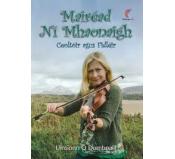
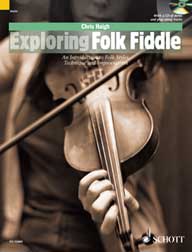
Traditional Irish fiddle music is a living, breathing thing, passed on from one musician to the next at sessions where everyone plays by ear and from memory. By committing the tunes to paper, there is an inherent danger of stultifying and homogenising the music, making it a consumer item rather than a piece of continuous creativity. What makes writers like Pete Cooper valuable is that they so completely understand the nature of the music that they are able to teach, in lessons, workshops, and books like this, how to get a complete understanding of not just how to play the notes of a tune, but how to breathe life into them.
The book ambles through 80 tunes- mostly jigs, reels, hornpipes and polkas, along with a few airs, marches, waltzes, mazurkas, highlands and slip jigs. It is however far more than a collection of tunes. As the book progresses ornamentation and bowing are gradually introduced and elaborated, along with a wealth of background and history both to the tunes and to the music in general. Cooper includes a whole array of erudite and entertaining quotes from all manner of sources, and his format of interspersing anecdote, history and stylistic observation gives the feel of him being in the room with you, fiddle in hand, delivering a relaxed and jovial lesson or workshop.
If you’ve never played traditional Irish music before, the approach is simple and basic enough to draw you in and set you on the right road, but even for the experienced player there is substance enough to give you plenty of food for thought. Most fascinating, perhaps, are his observations on the ever-changing nature of the tunes themselves which, far from being preserved like historical documents in a museum, can exist with a dozen different titles, versions and variations, so that even a single player might never play a tune the same way twice.
Three quotes from the book sum this up:
“Irish fiddle music has three variable elements- bowing, ornamentation and melody- and, by juggling them, the experienced player can generate countless variations within the parameters of the style”
“None of us, thanks be to God, are ever really in charge of what happens to traditional music”
"As long as the music is alive and changing, there will in fact never be such a thing as “the complete Irish fiddle player”
This is a book packed with knowledge, humour and wisdom. It has become a classic, and when you read it you’ll see why
The historic collection of fiddle tunes assembled by Chief O'Neill in 1903, and still in constant use by traditional musicians today. Contains 1001 tunes including jigs, reels, hornpipes, waltzes and many O'Carolan tunes. Includes a concise introduction to ornamentation.
There are many tune collections for Irish fiddlers, but this book is more than that; it takes you through from first principles how to handle the fiddle and bow, and to get to grips with reading music for the first time. It starts off with some extremely simple tunes, such as the German Polka and the Three Note Jig. Bowing techniques and ornamentation are gradually introduced, with exercises to master the cut, the double cut, triplets, long , short and tied rolls. The different tune types (polkas, jigs, slip jigs, reels, slow airs, slides and hornpipes are all explained.
The tunes early on in the book have full bow marks, slurs and ornamentation written in, whilst the later ones are left unadorned- less informative, but a lot easier to read, and leaving you room for your own interpretation. The collection includes many well known session standards such as Morrison’s Jig, Cliffs of Moher, Off to California, Planxty Irwin and The Boys of Bluehill, ; there are 84 in all.
Aside from the practicalities of learning the fiddle and building a repertoire, there is also some interesting background information on the instrumentation of Irish music, and the different regional styles around Ireland. All in all, this is a book written by an experienced fiddle teacher who leads you in easy and logical steps through the stages of learning traditional Irish fiddle. Even if you’re already a violinist with classical training, ignore the first chapter and this will still be a valuable book because, as any fiddler will tell you, there’s a lot more to traditional music than just reading the notes.