
MENU TO FIDDLE STYLES:
Indian violin
To the ear of the western violin player Indian music, and perhaps the Indian violin in particular, is one of the most exotic and mysterious of sounds. And this is not merely superficial, for the more closely you examine the complexity and discipline of the Indian Classical tradition, the more mysterious and baffling it becomes.
There are two main branches of classical music in the Subcontinent; the Carnatic or South Indian, and the Hindustani or Northern. The two styles diverged around the 14th Century AD, but have common roots dating back to the 4th Century BC. The biggest difference between Indian and Western Classical music is that the former is based very largely on improvisation, with emphasis on the creativity of the performer rather than on the exact reproduction of a composer's work.
Raags
The performer must work within a rigorous and complex framework of scale and rhythm; it is the ability to be inventive within these restrictions that marks out the quality of an artist. In Carnatic music for example there are 72 main scales or Melakartas, each of which has its own set of ornaments and Gamakas (grace notes); and 35 principal rhythms or Talas. A performance or Raag, which may last for several hours, will specify the use of a combination of certain melakartas and talas, and will have a simple melodic line, often from a religious or folk song; this however may not appear until late in a piece, and most of the performance is spent in examining and elaborating the particular mood and feel of the Raag. Raags were originally based mainly around the vocal tradition, and are not instrument-specific; indeed it is remarkable to hear the similarity in tone and ornamentation when comparing vocal and violin performances of a raag.
Probably the most important melody instrument is the Sitar, a plucked stringed instrument whose characteristic whining and "zinging" sound comes from the many sympathetic drone strings, and the ability to bend the strings sideways, thus sliding the note. An instrument called the Ravanastron is said to be the earliest ancestor of the fiddle, in that it was the first stringed instrument played with a bow. King Ravana of Ceylon is said to have invented the bow, and the instrument he used it on was named after him- the date for this is either 3000 or 5000 BC depending on what source you believe. Other stringed instruments include the Tambura (a four-stringed drone instrument, the Sarod (a small sitar), the Surbahar (bass sitar) and, from Hindustan, the Sarangi.
The Sarangi: A hundred colours
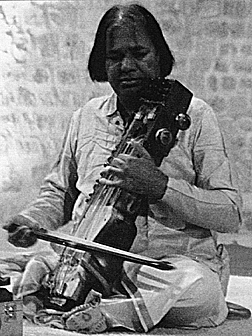
The Sarangi is a strange and ancient relative of the European violin which is both highly expressive and extremely difficult to play. Its name means "a hundred colours", indicating the range, depth and subtlety of its voice. The instrument expresses, according to the late Sir Yehudi Menuhin, "the very soul of Indian feeling and thought". It has an important and growing role in North Indian music, but has largely died out in the south.
It is said that the Sarangi originated in ancient times when a weary travelling hakim (doctor) lay down under a tree to rest in a forest. He was startled by a strange sound from above, which he eventually found to be caused by the wind blowing over the dried-up skin of a dead monkey, stretched between some branches. With this unlikely event as his inspiration, he proceeded home and constructed the first sarangi
It is squat and box-like, carved from a single piece of hardwood (usually Indian Cedar), with three gut melody strings (tuned do-so-do) and a baffling array of up to 40 metal tarab (sympathetic strings). The body has a goatskin face on which rests an elephant-shaped bridge of ivory or bone. The Sarangi is held vertically, neck uppermost, and the strings are stopped not with the fingertips but with the backs of the nails. A characteristic feature of sarangi playing is the very smooth meend (glissandos) and gamakas (oscillations around the note). Talcum powder is used on the palms of the hands to facilitate easy sliding on the neck.The heavy bow is held with an underhand grip, the first and second fingers placed between the hair and the stick. Among the current masters of the instrument are Pandit Ram Narayan and Ustad Sultan Khan; they have achieved conspicuous success despite a general decline in the fortunes of the sarangi, brought about both by its poor image (associated as it is with the accompaniment of dancing-girls), and by competition from the considerably sturdier and less troublesome harmonium.
Besides the classical sarangi described above, there exists a whole extended family of instruments either called by the same name, or structurally very similar, across the whole of North India, Pakistan and Afghanistan.
Indian violin
The violin may have been introduced to India around 1790 by military bandsmen in the East India Company, many of whom were Irish. Baluswami Dikshitar learned the instrument from the army bandmaster at Fort St.George in Madras, and developed new playing techniques to suit Carnatic music; he became court musician in Attaiyapuram. It has also been suggested that the violin came somewhat earlier, brought by Portugese Christian missionaries, and taught to converts for use in church services. Either way, the instrument was quickly found to be ideal for use in Indian classical music, with its closeness in timbre and range to the human voice. The violin is played sitting cross legged, the instrument pointing to the ground with scroll resting firmly on the ankle of the right foot. Traditionally fingering is based around the middle finger (which slides up), and the index finger (which slides down); these slides or portamenti, called meend in carnatic music, are sometimes facilitated by oiling the fingers. Open tunings, such as DADA or FCFC are commonly used in order to incorporate the drones which are such an important part of Indian music. The bow is held more in the folk than western classical style. Vibrato is not used as in Western music, though there are slow, deliberate oscillations (andolan) and faster oscillations called gamak.The aim of tone production is to imitate the Indian singing style. Grace notes (sparsha svara or krintan) are frequently used. Hindustani music alone has over a hundred categorised ornaments. There is extensive use of micro-tones, and a choice of alternative tunings to utilise drone notes; the violin is often tuned in fourths rather than in fifths, eliminating the need to use the fourth finger.
The violin has become well established in Carnatic music, principally as an accompaniment to the voice, but also sometimes as a solo instrument.
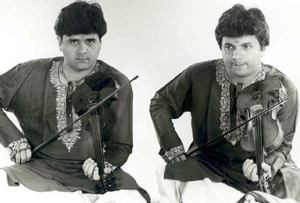
Ganesh and Kumaresh- a Carnatic violin duo
It has assumed a similar role alongside the sarangi in Hindustani music in the hands of such players as VG Jog and Gajanarao Joshi.
Indian music first became widely known to the popular audience in the West in the late 1960's, when George Harrison, with the Beatles, visited India in search of alternative methods of mind-expanding spiritual enlightenment, and discovered, perhaps more usefully, the playing of sitar guru Ravi Shankar. Much musical cross-fertilisation followed, one of the most fruitful results being guitarist John McLaughlin's group Shakti, which included the violin genius L.Shankar.
L.Shankar with 10-string double violin
L.Shankar, as well as being a top player in both the Western and Carnatic classical traditions,uses his dazzling virtuosity to full effect in rock and jazz fusions with such artists as Peter Gabriel, Jan Garbarek, Frank Zappa, Talking Heads and fiddler Mark O'Connor. He has an astounding double-necked, 10-stringed electric violin giving him the full range of the string quartet- an instrument which would appear ridiculous and totally pretentious in the hands of almost any other violinist.
His brother is another famous violinist, Dr. L.Subramaniam (and it seems almost de rigeur for every Indian violinist to have a father, brother, sister and chiropodist who are famous and talented musicians). L.Subramaniam, like his brother, is a master of both western and Carnatic classical music, is a prolific composer, and is involved in East-West fusions, for example with Stephane Grappelli.A recent newcomer to London is S.Harikumar, from Kerala in southern India; having studied with, among others, L.Subramaniam, he has developed his own Indian Jazz Fusion style, making good use of a technical mastery of staccato bowing techniques, and fluent playing up to the fifth octave.
S.Harikumar plays both 4-string acoustic and 7-string electric violins.
Harikumar
Contrary to the popular belief that all leading Indian musicians are men, one of the greatest of all pioneers of Hindustani violin in recent times is a woman, Dr.N Rajam ; her daughter Sangeeta Shankar is also a leading player.
A brief dip into Indian music quickly reveals that it is a deep and vast subject, its performance requiring great discipline and spiritual awareness. Consider this quote, next time you reach for a well-earned pint after scraping merrily through Old Joe Clark or Drowsy Maggie; "The purpose of Indian music is to refine one's soul, discipline one's body, to make one aware of the infinite within one, to unite one's breath with that of space and one's vibrations with that of the cosmos."Links;
- Nicholas Magriel's Sarangi site
- Spic Macay's sarangi page
- A Brief biog of L.Subramaniam
- India Heritage; an introduction to Hindustani music
- Chembur.com's sarangi page
- ragaculture; an intoduction to Hindustani music
Chris Haigh is a freelance fiddler and writer based in London. He has worked with the leicester Based Bollywood band Diwana Arts and with S Harikumar. He has had several books published: Fiddling Around the World, Any Fool can Write Fiddle Tunes, (Spartan), The Fiddle Handbook (Backbeat/Hal Leonard) and Exploring Jazz Violin (Schott)
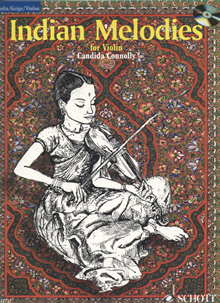
Indian Melodies: for Violin (Schott)
An excellent and authoritative introduction to Indian violin playing is provided by Candida Connolly's book. She has studied in India with N.Gopalakrishna Iyer, and teaches at Trinity College London and at the Bharatiya Vidya Bhavan (Indian Cultural Centre). She covers the basic ornaments and ragas of both North and South India, explains Indian musical notation, and provides several studies, songs and ragas, along with a 21-track CD.