MENU TO FIDDLE STYLES:
Klezmer Fiddle
This page has moved. For the updated version, please click here!

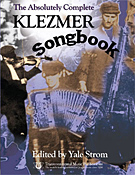
The Absolutely Complete Klezmer Songbook

If anyone can be called an expert on Klezmer, it’s Yale Strom. With ten books, ten CD’s, six documentary films, two plays, a symphony, and twenty five research expeditions in central and Eastern Europe to his credit, Yale has clearly dedicated a large part of his life to the study and revival of klezmer in all its forms.
This book opens with a detailed history of klezmer from its earliest roots in the time of the Temple of Jerusalem, through the tortuous history of the Jews in medieval Europe, where not least among the problems musicians faced was the disapproval of their own rabbis. Weddings have always been the central focus of klezmer, and Yale documents the gradually changing role of the musician; “over time the profession of the lets (an all purpose entertainer) evolved into those of the marshalik (master of ceremonies), and the batkhn, the wedding bard. These names were sometimes used interchangeably…it appears that these various occupations gradually melded into that of the klezmer, a term popular from the 18thC through today.” The role of violinist as band leader and emotional focus of the music is examined; “The klezmer violinist was an extension of the khasn’s voice”, and “the klezmer’s ability to imitate the crying, ululating, moaning and laughing cantorial techniques he had heard since he was an infant were shaped into specific klezmer ornamentation”
Five dreydlekh or core techniques are described, as well as the four chief modes on which klezmer melodies are constructed. The claim that this is the “absolutely complete” klezmer songbook may be an exaggeration, but with 313 numbers who’s to complain? Henry Sapoznik’s The Compleat Klezmer had just 33. The tunes are grouped by type; Processionals, Bulgars, Freylekhs, Horas, Skotshnes, Shers, Nigunim and so on, and they range from tunes known universally in the Jewish world, to rare treasures that he has unearthed on his travels. Thirty six of the tunes are recorded on an accompanying CD and, unusually for a “book cd”, these are quality recordings with Yale’s violin accompanied by his band Hot Pstromi; the tunes are beautifully arranged and played, making this a proper listening cd in its own right. A second CD, “Absolutely Klezmer Volume 2” is available separately, with a further 17 tunes from the book, this time with longer arrangements and some extended improvisation.
This book is a gem, and with people like Yale Strom behind it, the Klezmer revival is in safe hands.
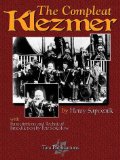

Henry Sapoznik had a key role in the late 20thC revival of klezmer in the United States, and this book was one of the major sources of dissemination of the almost-lost repertoire. The 33 tunes are written clearly and simply, the keys (often D minor or D major) easily accessible on the fiddle. Divided into Horas, Terkishes, Khosidls, Khupes and Doinas, many of these numbers are at the core of the klezmer repertoire. Among the best known are Tanz, Tanz Yidelekh, Ot Azoi, Der Shtiler Bulgar, Odessa Bulgar, and Kandel's Hora.
Sapoznik's intoduction gives a deep insight into the circumstances surrounding the revival, and the notes by Pete Sokolow give an invaluable summary of the dance forms, scales, rhythms and instrumentation of klezmer. The discography is revealing; writing in 1987 he could list less than a dozen contemporary klezmer bands with recordings. Today the list would be in the hundreds; and there would be few of those musicians who would not admit to owning a well-thumbed copy of The Compleat Klezmer.

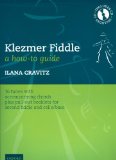
Cravitz, Ilana - Klezmer Fiddle: a How-To Guide - Book and CD for Violin - Oxford University Press
Playing klezmer fiddle is as much about the sound as the tunes. To bring them to life you need to understand many aspects of bowing, articulation, phrasing and ornamentation which are not obvious from the melodies. Ilana Cravitz's book provides the detailed analysis of performance which will give you the authenticity of sound which will make you a real klezmer player.Trills, slides, the krekhts ( a sort of fingered sob), finger positions and vibrato are all demonstrated with reference to 16 tunes. The playing on the accompanying cd is clear and authoritative, and also included are separate parts for sekund (rhythm fiddle) and bass, making this a valuable resource for anyone starting up a klezmer band from scratch.

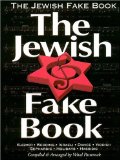
The Jewish Fake Book (Fake Books)
Despite the success of the Klezmer rivival, the material that remains most popular at most Jewish weddings and bar mitzvahs is this "Simcha music"; mostly relatively modern modern compositions, usually vocal, in Hebrew, and usually recorded with "pop" backing. It's not my cup of tea, but nevertheless these tunes are essential, and until I got hold of this book, my only way of accessing them was by copying them from other musicians' pads. The Jewish Fake Book has 180 tunes, subdivided into "Klezmer and Wedding", "Israeli Dance", "Songs of Israel", "Yiddish", "Somgs in English", "Sephardic and Oriental", "Sabbath and Holidays", and Hassidic and Liturgical". They all come with words and chords as well as top line. Learn these tunes and you'll never be out of work. At least, never on a Sunday!

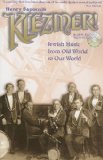
Klezmer! Jewish Music From Old World To Our World (Omnibus Press)
This is a fascinating, detailed and comprehensive history of klezmer from its roots in eastern and central Europe, the establishement of musical guilds and klezmer dynasties, the 19th C exodus to America, the twists and turns of Yiddish popular music in the New World, to the decline and eventual late 20thC revival. As a key figure in this revival, Sapoznik is able to give an engaging and very personal view of this revival, and he has added many wonderful and colorful details to our knowledge of klezmer. Of most interest to me was the section on Yiddish Melodies in Swing; the 1930's and 40's fusion which gave us such songs as And the Angels Sing, and Bei mir Bist du Shon.
There may be a great deal of scholarly research in here, but writing is informal and accessible, and this is a book of interest to musicians and non musicians alike. It comes with a 22 track cd including many rare and historic recordings, including the legendary Belf Romanian Orchestra, Abe schwartz's orchestra , and the great clarinetists Harry Kandel and Naftule Brandwein.
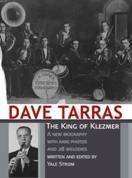
Dave Tarras - The King of Klezmer

by Yale Strom
Dave Tarras, the King of Klezmer, was not only arguably the greatest klezmer clarinettist of his generation, but the longevity of his life and career made him a unique figure in klezmer history. It was a career that spanned the Old World of Tzarist Russia, the pogroms, emigration to the USA, the golden age of klezmer and Yiddish theatre in New York, the postwar decline and eventual 1970’s revival. He was part of all this: “Tarras represented that last link to the klezmer world of the late 19thC and turn-of-the-century era”; and Yale Strom’s biography gives us an intimate and detailed insight into that career, based on deep research and many personal interviews.
Tarras’s talent shone from the earliest age, whether it was in his family kapelye in Ternovka, Russia, in the Tzarist army ("at night while he entertained the officers, the rest of his bretheren were on the front fighting the Germans. For a while, music shielded Tarras from the horrors of war”, or in the dance halls of New York; “there is nothing he did that was not immediately taken up by other clarinettists” Strom leads us on a fascinating story right through to Tarras’s death in 1989, at the age of 92. By this time the new generation of klezmer musicians, fellow clarinettist Andy Statman in particular, were fully aware of the importance of his legacy.
This book, rounded off with a collection of 28 Tarras compositions (presented in both C and Bb), is a resource which any klezmer player, whether a clarinettist or not, should treasure.