
MENU TO FIDDLE STYLES:
Scottish Fiddle
PART ONE ; The History of Scottish Fiddle Music; PART TWO ; Regional fiddle styles in Scotland; PART THREE ; the music-tune types, modes, bowing and ornamentation; PART FOUR ; Contemporary Scottish Fiddle
1.The History of Scottish Fiddle Music
The titles of Scottish fiddle tunes read like a mixture of a history lesson, a travel brochure, and a Who’s Who of Scotland.
Consider such titles as The Marquis of Huntley’s Farewell, Mr Murray of Pittaendreich, The Battle of Harlawnverugie, Culloden, Rousing the Nation, Bridge of Perth, King Robert the Bruce, Well may Charley Wear the Crown….. It is told how the good people of Edinburgh, on the occasion of a visit by Mary Queen of Scots to HolyRood Castle, chose to show their devotion by serenading her with their fiddles, en masse, beneath the castle walls. It is perhaps less often mentioned that, dismayed by the vile noise of 500 fiddles and rebecs (and, let’s be honest we can assume they didn’t spend a lot of time rehearsing or tuning up), she demanded to be given a room at the rear of the castle, as far away as possible.
The introduction of the violin to Scotland
The violin had probably been introduced to Scotland from England around 1670, and was much prized (though perhaps not by Mary) among the nobility. It rubbed shoulders with its medieval ancestors the rebec and vielle; one of the earliest mentions of the fiddle is in the royal treasurer's accounts for 1497, which mention a payment "at the kingis command, to the fidilar in Dunbar".
Despite the occasional favour of the king, medieval fiddlers were often held in low regard in Scotland, and a declaration in Edinburgh in 1587 demanded that "all mestrallis (minstrels)...fidleris (fiddlers), commoun sangsteris (singers), especially of baldrie and filthy songs...remove and depart furth..."
These early fiddles rubbed shoulders with the violin before finally being replaced by it due to its superior tone and playability. When King Charles II, the so-called “Merrie Monarch” came down from Edinburgh to take the English throne in 1661 one of his first acts was to bring down his band of 24 fiddle players, led by a German violinist Thomas Baltzar. By this time the nobility were more interested in European music than traditional Scots tunes, but throughout Scotland, fiddling was about to enter its Golden Age.
Thomas Baltzar
Across the sea in Ireland, English invasion and repression led to virtually the entire Irish aristocracy leaving the country (the Flight of the Earls (1607) and Flight of the Wild Geese (1691), the working class was left impoverished, and there was little or no indigenous middle class. Centuries of Celtic culture and music were fractured from their roots, and fiddling was the domain of the poor, illiterate and often the blind. In Scotland, by contrast, notwithstanding the Jacobite Rebellions and the Highland Clearances, there was a thriving economy, an articulate and well educated middle class, and an aristocracy who were happy to sponsor and patronise the arts. Following a century of religious repression during the Reformation, the whole of Scottish society returned with enthusiasm to the arts, music and dancing, and most specifically fiddling. Whilst in Ireland the best fiddlers of 18th and 19th Centuries, and those who composed the great body of today’s repertoire, remained largely anonymous, in Scotland a host of fiddlers made their mark on history. Almost all of the great fiddlers were also composers, and their tunes, instead of being passed on aurally, were named, written down (often with detailed annotation on ornamentation and bowing), and published in collections.
Scottish Tune Collections
Among the earliest of these was a collection of tunes entitled “The Caledonian Pocket Companion”. This was published in 12 volumes over a number of years by James Oswald. Born in Fife in 1710, Oswald was a talented and industrious man; a cello player who discovered a talent for composition and publication. Following the Union of Parliaments in 1707, when the Scottish and English states were unified, Scotland saw a renewed interest in its national culture, and Oswald was among the first to translate this enthusiasm into something practical. His successful first effort was “A curious collection of Scots tunes”, which he published in 1740. Emboldened by the very respectable sales of this volume, he moved from Edinburgh down to London, where he attempted to set himself up teaching, composing and, once more, publishing. His timing was unfortunate; in 1745, not long after his arrival, the second Jacobite Rebellion took place; Bonnie Prince Charlie landed in the West Coast of Scotland, in an attempt to take the throne and re-unite the country as a nation once more independent of England. As a Scot living in London Oswald was obviously under suspicion, particularly as his chief Scottish patron, the Duke of Perth, had been a prominent supporter of the rebellion. Ever the pragmatist, Oswald, predicting, correctly, that the rebellion would fail, took the bold step of reprinting his “Curious collection”, this time with a dedication to Frederick, Prince of Wales, thereby demonstrating his allegiance to the British crown.
His gamble was successful; the book sold well, and he followed it up with a series of volumes (the Caledonian Pocket Companion), starting in 1745. The first of these publications was aimed at flautists, but he soon realised that the fiddle was a much more popular vehicle for the playing of Scottish music, and future volumes were targeted much more in this direction. Along with traditional tunes, many of his own compositions were included, including some, such as the East Neuk of Fife which are still popular today. The Jacobite rebellion was crushed at the Battle of Culloden in 1746, and was followed by parliamentary acts designed to stamp out symbols of Scottish independence, including the wearing of tartan and, more significantly, the playing of the highland bagpipes. This led to a considerable transferral of both repertoire and playing techniques from the pipes to the fiddle (which fortunately was not banned). This move was reflected by Oswald, who began transcribing famous pipe tunes such as Mcintosh’s Lament (a 200 year old pibroch-a type of extended improvisation in memorial of a dead clan chief). Since pipers had always learned and played by ear, such tunes had never been written down. Oswald reproduced the effect of the pipe’s drones by using an open tuning (AEAC#). The survival of these ancient tunes was therefore assured, along with many of the details of performance and ornamentation. Although following Oswald’s death in 1769 his books were not reprinted, there were enough in circulation to assure that the next generation of fiddlers were both aware of the repertoire he had collected, and of the not inconsiderable profits that could be made by such endeavours.
Robert Burns and the Fiddle
Among the many people to own and treasure the Pocket Companion was Scotland’s national poet, Robert Burns. Born in 1759, Burns was a fiddler himself, though not to any great standard. He quickly found a gift for putting words to fiddle tunes; it was no mean task to match the rhythm of such tunes with meaningful and poetic lyrics, especially with the complex phrasing of the newest form of tune, the strathspey. Among the songs he wrote to tunes from Oswald are “The Deil’s awa’ with the exciseman” and “Ae fond Kiss”
Robert Burns
Burns described a wandering fiddle player in his "love and Liberty";
"a pygmy scraper wi' his fiddle/ Wha us'd to trystes an' fairs to driddle"
Fairs were an important venue for fiddlers; an almanac from 1632 lists 161 of them throughout the year and all across Scotland. In Burns's song Rattlin Roarin Willy, a fiddler sets off to a fair intending to sell his fiddle, but changes his mind;
"O Willie come sell your fiddle/ come sell your fiddle so fine
O Willie come sell your fiddle/ and buy a pint o'wine
If I should sell my fiddle/ the worl' would think I was mad;
for many a rantin' day/ my fiddle and I hae had"
Burns did not always appreciate the fiddlers he encountered. On one occasion he complained that "since dinner, a scraper has been torturing catgut, in sounds that would have insulted the dying agonies of a sow under the hands of a butcher".
Not all itinerant fiddlers were beggars or buskers. Between 1750 and 1850, as in Ireland and England, there were many professional dancing masters who travelled the country giving dance tuition to workers and gentry alike. Alan Dawson, in his "The fiddler and his art" describes such a character;
"The dancing teacher used to come and take a local hall; the fellow taught us dancing...he would dance on the platform and play the fiddle at the same time, demonstrating the dance and keeping time to the music" .
A source of tunes for Burns was his friend and contemporary, and among the greatest of all Scots fiddle players, Niel Gow.
Niel Gow
Gow was born in the Perthshire village of Strathbraan, in 1727, and initially trained in his father’s trade of weaving. However, at an early age he showed great aptitude for the fiddle, and by 18 was able to demonstrate his prowess by winning an open competition in Perth. He was already well known for his powerful and highly distinctive bowing style, to the extent that the judge, a blind fiddler, specially chosen so that he would not give favouritism to the young lad, was able to state that he “would ken his bow hand among a hunder players”. The year of the competition was 1745, the year of the Jacobite uprising. The Duke of Atholl, who was to become a lifelong friend and patron of Niel Gow, was one of many among the Scottish nobility who opted not to back the uprising, but hurried off to London to avoid any trouble. The Duke’s brother William opted to stay, and hired Gow for a grand ball in honour of The Young Pretender when he stayed there on his march to Edinburgh; the fiddler may also have been among those Atholl tenants conscripted or persuaded to join the march; if so he was also among the many to abandon it in short order, thereby avoiding the final massacre at Culloden. Over his lifetime Niel Gow enjoyed the patronage of three succeeding Dukes of Atholl, and was guaranteed a steady supply of work at balls and dances both near and far. He performed in a small band , often with a second fiddle player, and with his brother Donald on cello. They would often walk miles to perform at some great house, drink rather too much, and then stagger home in the wee hours; referring to such a journey home he would complain that “it wasna the length of the road but the breadth o’ it” that worried him ( since he had a hard job keeping in a straight line!)
Niel Gow
He was highly respected by all classes not only for his fiery playing and his memorable and prolific compositions, but also for his sense of humour, and his honest and straightforward manner. Robert Burns, who visited him in 1787, described him as “A short, stout-built honest Highland figure, with his greyish hair shed on his honest social brow; an interesting face, marking strong sense, kind openheartedness mixed with unmistrusting simplicity”. Niel Gow is often credited with inventing, or at least popularising the famous “Scotch Snap” which has become perhaps the trademark feature of Scottish fiddle playing, and was famous for his “updriven bow”, a style which emphasised the up bow in reel and strathspey playing more than the down bow. Among his most famous compositions was the beautiful air Niel Gow’s lament for the death of his second wife, along with the reels Farewell to whiskey (written in dismay at the failure in the barley crop in 1799), and Mrs McLeod’s Reel He died in 1807 at the ripe old age of 80; his tombstone, with a humour befitting the man, read “Time and Gow are even now; Gow beat time, now time’s beat Gow”.
Niel Gow’s legacy lay not just with his reputation and his published tune collections, but also with his sons, two of whom led fashionable bands in Edinburgh. Nathaniel Gow, the fourth son inherited all his father’s genius as a composer, (he is credited with such classics as The Fairy Dance, Gallowglass and so on), and went on to be a highly successful publisher in his own right.
The 18th and 19th Centuries saw many gifted, skilful and celebrated fiddlers, including such names as William Marshall (1748-1833), Simon Fraser (1773-1852), Isaac Cooper (1755 -?) and Charles Grant (1806-1892). None however could compare either for fame or notoriety with James Scott Skinner, the Strathspey King.
J Scott Skinner
He was born in 1843, with a chip on his shoulder. He had an extremely hard upbringing, regularly bullied and beaten by his mother, stepfather, brother and schoolteacher. Much of the success he eventually achieved seems to have been driven by a desperate need to prove himself to one and all. In contrast to the amiable and modest Niel Gow, Skinner was a self-important and somewhat pompous figure who never missed an opportunity to blow his own trumpet or talk down a rival.
Scott Skinner
He was taught by his older brother to play the violin and cello; he was a precocious student and at the age of eight was accompanying the noted fiddler Peter Milne at local dances, earning himself the princely fee of 5 shillings a month. As was the custom at the time they would have to walk home after the performances, and Skinner tells how he was sometimes so exhausted on his return that he would fall asleep outside his own front door.
At the age of 11 he was taken on by a touring boys’ group “Dr Mark’s Little Men”, with whom he performed on violin and cello around Britain for a number of years until he was dismissed after a punch-up with one of the other boys. At some point he was given classical lessons and taught to read and write music by the French violinist Charles Rougier; a valuable skill as he had always played by ear up this point. On returning home to Scotland in 1861 he was taken under the wing by William Scott, who taught him to dance, and trained him to be a professional dancing-master. Skinner so grateful for this help and kindness that he adopted Scott as his middle name ( a more cynical view would be that this was merely an excuse to incorporate in his name an association with Sir Walter Scott, the great romantic poet, or indeed with Scotland itself).
In 1862 J. Scott Skinner, as he was now known, won a Highland Dancing competition in Ireland ( accompanying himself on the fiddle- that must have been quite a sight!), and the following year he triumphed at a violin contest in Inverness. By this time he had become a fearsome and highly individual player, incorporating many classical techniques he had learned from Rougier- fancy bowing, use of vibrato, arpeggios, harmonics and bold adventures into the higher positions. He began producing compositions which, whilst being within the traditional Scottish genre (airs, marches, reels and strathspeys), were deliberately designed as vehicles to show off his superior technique to the other “country bumpkin” fiddlers. Referring to his predecessor Niel Gow, he said he “did good work, but would have soared even higher if (he had)....received a good sound training”
His work as a dancing master gradually gave way to proper performance work as his fame spread; he was perhaps the first Scottish fiddler to present Scottish traditional music not as something for the village hall dance floor, but for the listening appreciation of the discerning concert audience. His performances included Scottish tunes alongside his own compositions, and those by Paganini and Mozart.
Following a tour of America and Canada in 1893 he took to wearing the kilt and full highland regalia as his regular outfit for performance, and he began to take on the mantle of a self-appointed icon and ambassador of the Victorian ideal of Scottish romanticism. He became the first Scottish fiddler (I believe actually he would have thought of himself very much as a violinist rather than fiddler) to be recorded, and appeared at the Albert Hall and London Palladium. He produced a huge output of compositions, and along with his many tune collection (the most famous being “Harp and Claymore (1904), he wrote a “Guide to Bowing” and his own, typically overblown memoirs “My life and adventures” A taste of the latter is given by his comment "I have no intention of wearying my readers with the details of my life's output of original music, which, frankly speaking, has been colossal”
His death in 1927 left behind both a valuable legacy and a lasting controversy. His tunes still make up a sizeable part of the repertoire played today, from relatively straightforward reels (The Spey in Spate, Mrs Forbes Leith, James Hardie), stately airs (The Music O’Spey), Strathspeys (Glenlivet) to technically challenging pieces such as The Mathemetician (peppered with triplet runs and ascending casually to 6th position) Madame Vanoni ( a showcase for artificial harmonics) and The President (a full blown symphonic fantasy of a fiddle tune- the first bar is enough to scare me off!) His published tunes, both of his own work and that of others) are given detailed and specific annotation as to bowing and ornamentation; to work through a number of his tunes is akin to a degree course in advanced bowing and fingering. He has undoubtedly, (and he would have added, single handedly) raised the overall standard and expectations of Scottish fiddle playing, and demonstrated that it can sit proudly alongside Paganini and Mozart as a true art music. On the other side of the coin, he has introduced a strong element of elitism and snobbery, encouraging showy technique over emotion. When Irish fiddling today is compared to Scottish fiddling, much of the difference and contrast in approach can be put down to the influence of Skinner.
PART ONE ; The History of Scottish Fiddle Music; PART TWO ; Regional fiddle styles in Scotland; PART THREE ; the music-tune types, modes, bowing and ornamentation; PART FOUR ; Contemporary Scottish Fiddle
___________________________________________________________________________
Check out my London-based Ceilidh band QUICKSILVER
Chris Haigh is a London-based fiddle player. He plays many styles, but has a large repertoire of Scottish fiddle tunes, which he plays either solo (for private functions) or with his ceilidh band Quicksilver. He has appeared at the Edinburgh Folk Festival, the Glasgow Celtic Connections festival, and five times at the Shetland Folk Festival. He has written and recorded a cd of tunes in Scottish traditional style for use as TV production music; tracks from this album have appeared on programmes throughout the world.
Links:
- Article on Neil Gow
- Article on Scott Skinner
- A synopsis of Peter Cooke's book on Shetland fiddling
- Scottishfiddling.org
- Scottish fiddle.com (An excellent new resource including sheet music downloads)
- Catherine Fraser (Australian based Scottish fiddler)
- Linda Rankin (another Scots fiddler based in Australia)
- Scotchsnap.com (good online source for Scottish sheet music)
- Taransay Fiddlers (week- long fiddle course on a Hebridean island)
RETURN TO FIDDLINGAROUND HOMEPAGE
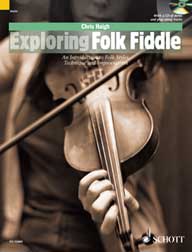
The Caledonian Companion
As part of a 200 year dynasty of Scottish fiddlers and violin makers, and founding member of the Hardie Press, Alastair Hardie is well qualified as writer of The Caledonian Companion.
This is much more than a collection of 112 traditional Scottish tunes. He introduces us to some of his noteworthy Hardie ancestors, along with such notable composers as the Gows, William Marshall and the great James Scott Skinner. For those new to Scottish music, he summarises the main tune forms and gives us some general performance notes on style, notation, accompaniment and so on.
The tunes are interspersed with notes on technique- particularly bowing, which is so vital to the correct interpretation of this music. There are also many brief comments about the origins of the tunes, and the significance of particular phrases and techniques. The tunes themselves are arranged roughly in order of difficulty starting, for example with some easy Scots Measures such as the White Cockade and East Neuk o’Fife, or well known reels such as Speed the Plough and the Deil among the Tailors.
Whilst there are many of these common standards, there are others which are not currently available in any other publication. Among the more challenging are the numerous strathspeys, some in difficult keys such as E flat, while as a finale we have Scott Skinner’s The President, the opening bar of which is enough make even the seasoned fiddler break into a sweat and start looking for excuses.
All in all this is a book worthy of its place in the long history of Scottish tune publication, and even if you only get half way through its 143 pages you will come away from it inspired, entertained, challenged and enlightened.